 Call Us
  Schedule Consultation




Unlock Your Most Refreshed Look
Aging is a privilege—but the visible signs of aging, like sagging skin, deep creases, and loss of facial volume, don’t always match the energy you feel inside. If you notice your reflection looking tired, heavy, or older than you feel, our Orange County facelift can help restore the youthful, vibrant version of yourself that still exists beneath the surface.
At Cruise Plastic Surgery in Newport Beach, Dr. Joseph T. Cruise offers facelift surgery designed around your natural facial structure. His philosophy emphasizes lifting and repositioning deeper structures—not just tightening excess skin—to create refined, long-lasting results that honor your natural features. Unlike traditional facelifts, Dr. Cruise uses the most advanced SMAS lift techniques to reposition deeper structures, creating a refreshed and enduring result. His meticulous surgical technique ensures that you still look like yourself—only younger, smoother, and more vibrant.
1 of 62
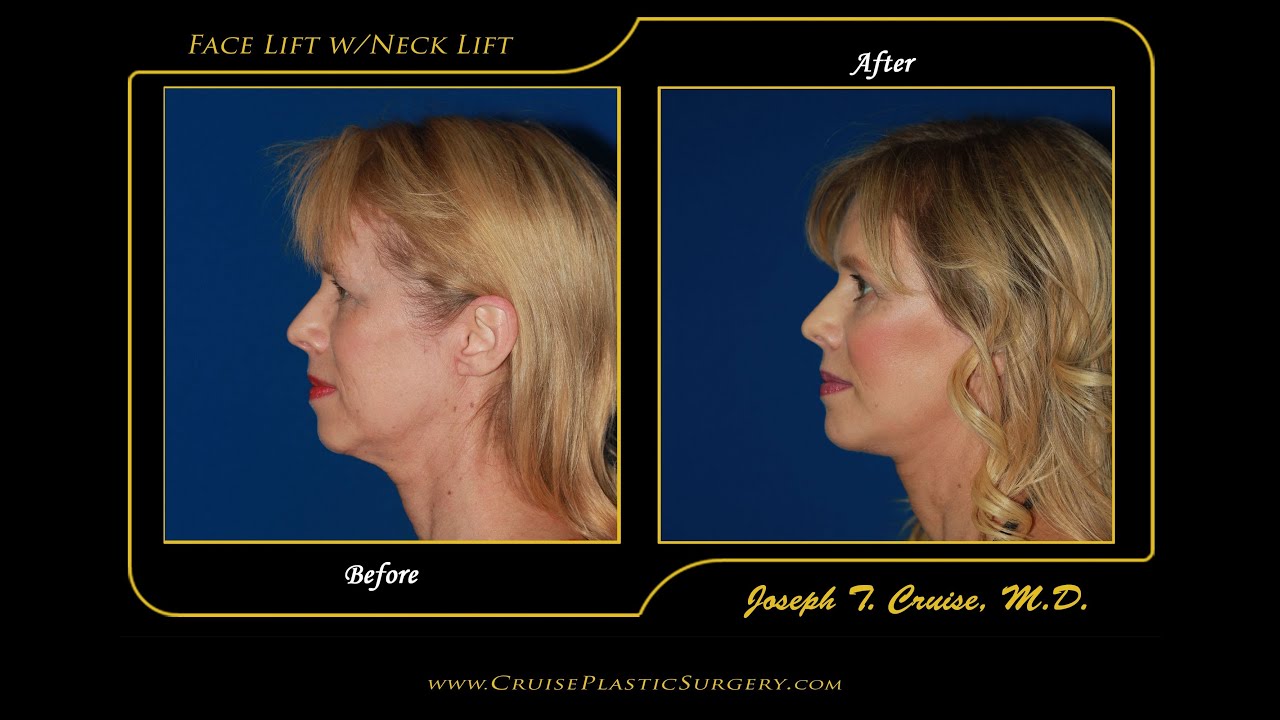
Every face is different, and in order to see the dramatic results for yourself, Joseph T Cruise, MD, has provided many before and after photos of facelift and neck lift patients. Most patients report they look and feel 10 to 20 years younger, which greatly impacts their state of mind and quality of life.
Our Orange County facelift (also known as rhytidectomy or face lift surgery) is a surgical procedure that lifts and repositions sagging facial tissues to rejuvenate the lower face, jawline, and neck. It addresses loose skin, deep wrinkles, and excess fat, restoring smoother contours and a more youthful appearance.
Many people think that facelift procedures simply tighten excess skin, and this was once the case. However, new research and progressive technological innovations have given plastic surgeons such as Joseph T Cruise, MD, a greater understanding of the underlying causes of facial aging and improved procedures to combat it. Unlike a traditional facelift that simply tightens skin, Dr. Cruise’s advanced technique targets the superficial musculoaponeurotic system (SMAS) and underlying facial muscles. This deeper approach produces natural-looking, lasting results without the stretched or “windswept” look sometimes seen with older techniques.
Joseph T Cruise, MD, addresses all facelift patients individually with a customized approach to evaluating the face.
Our custom facelift page outlines the specific effects of a number of common facial rejuvenation procedures, including upper and lower eyelid surgery, brow lift, fat transfer, neck lift, and chin implants. If you are seeking a personalized solution for your concerns, learn more about Joseph T Cruise, MD’s CustomLift® face lift. Full facial rejuvenation surgery results in pleasing, natural-looking results when all aspects of facial aging have been corrected.


Mastering the Art of Deep Rejuvenation

In order to achieve the best results from your facelift in Orange County, Joseph T Cruise, MD, and his dedicated patient care coordinators meet personally with each patient to discuss exactly what bothers them and what they are trying to achieve with facelift surgery. You will walk away feeling confident and empowered to make a decision about whether or not having a facelift is the right choice for you.
The staff at Cruise Plastic Surgery provides every patient with invaluable information before, during, and after the consultation, ensuring each person’s specific concerns are addressed. Proprietary software, developed by Joseph T Cruise, MD, provides in-depth information at every stage in the surgical process: decision making, consultation, scheduling, pre-op, surgery date, and recovery.
Facelift surgery is an outpatient procedure performed under general anesthesia or local anesthesia with sedation. The procedure generally takes 3 to 5 hours, depending on the extent of correction and any other procedures performed at the same time.
Incisions are created along natural creases, usually in front of the ear and extending into the lower scalp, where they are well-concealed. Through these incision sites, Dr. Cruise lifts and repositions the deeper tissues, including the SMAS layer, to support the facial skin naturally. Facial fat may be repositioned or facial fat grafting may be performed to rebuild lifted, youthful contours. This comprehensive approach avoids an over-pulled look, resulting in a refreshed, natural-looking appearance.
Dr. Cruise uses precision techniques to close the incisions, minimizing the risk of visible scarring. When surgery is complete, the patient is monitored in a recovery suite before being released to return home the same day.
Reversing the Visible Signs of Aging
Youthful facial skin has greater fullness because of facial fat and more elasticity because of supportive, stretchy ligaments that help hold the facial tissue in place. Loss of fullness and elasticity over time contributes to loose, sagging skin that causes many people to consider a surgical procedure to reverse these aging effects.
With a facelift Orange County patients get a highly customized procedure designed to address several common complaints of facial aging, such as:
Dr. Cruise’s advanced facelift technique considers the deeper structures of the facial anatomy to provide an elegant, natural-looking lift.

The interactive diagram below was created by Joseph T Cruise, MD, to help you identify what you don't like about your face now. This provides both you and Dr. Cruise a clear visual of what is bothering you and will help him formulate a customized treatment plan to address your concerns.
Click the images below to select your concerns in each category. If you would like to submit the form for review, one of Joseph T Cruise, MD's patient care coordinators will review your selections and contact you to discuss further.
Upper Face Concerns
The Aging Face Explained
It is important to understand the anatomy of the face and how it changes during the aging process. Joseph T Cruise, MD, addresses the face in four quadrants with a facelift. View each section below to see what procedures are available to treat the most common issues of facial aging.
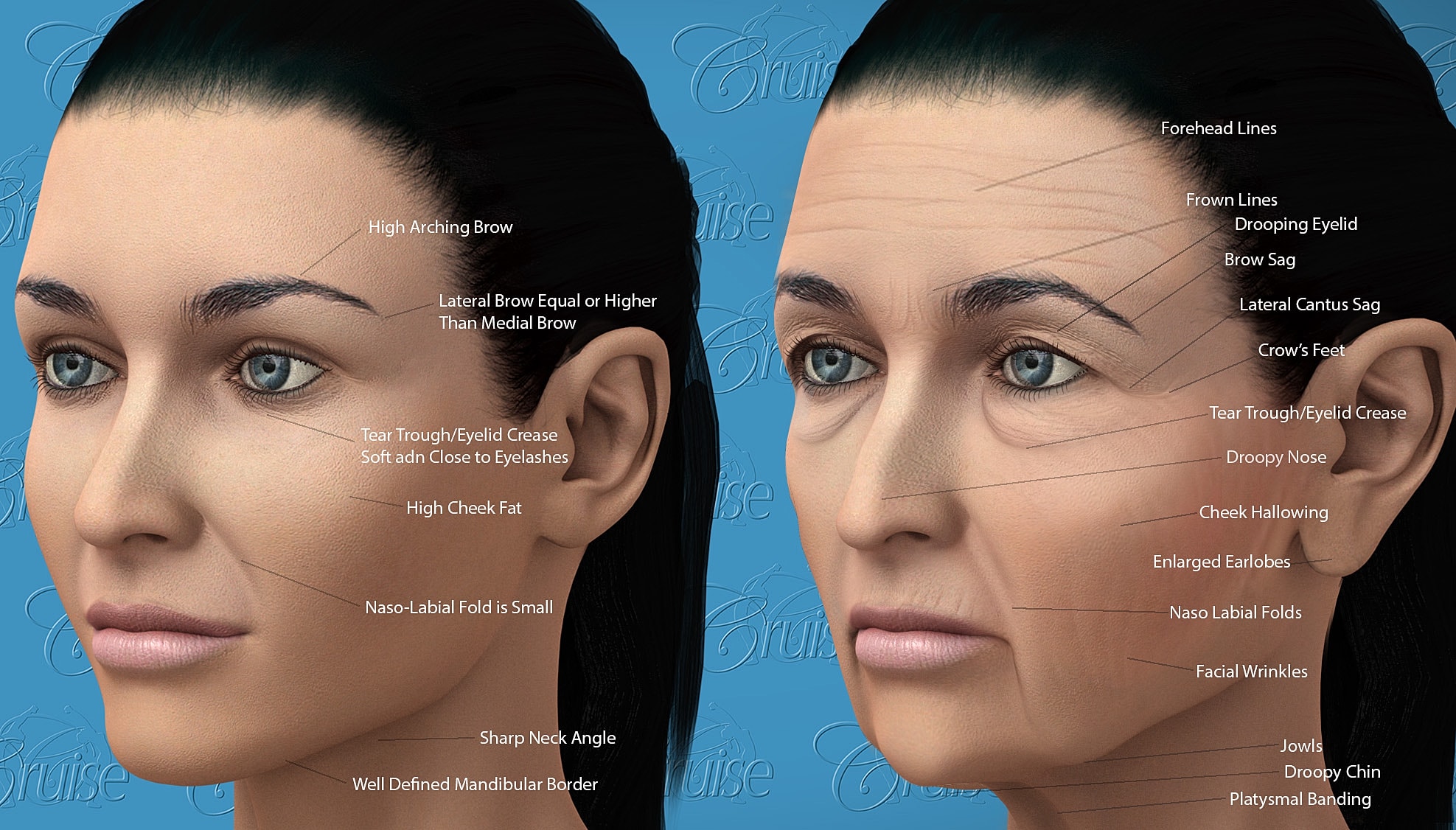
Tightening skin alone is not enough to correct all the potential causes of facial aging, such as saggy skin, crow’s feet, dropping eyes, and other concerns that cause people to wonder if facial plastic surgery may be right for them. As facial tissue loses its elasticity and facial fat either dissipates or descends, many people find that simply tightening skin is only a temporary solution, and later they choose to have additional cosmetic surgery to achieve the full results they desire from a face lift.
A simple and extreme explanation to demonstrate the importance of facial fat for a youthful, wrinkle-free face is to compare the chubby, rotund cheeks of a baby with the looser, thinner cheeks of a more mature face. Skin care treatments such as dermabrasion and chemical peels are part of the solution, but with fat transfer, you can reclaim the smooth, contoured facial features you enjoyed in your youth.
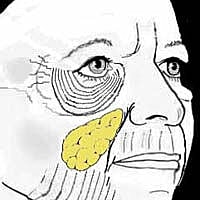
When facial fat descends out of the cheek and into the area around the lips, it not only affects the fullness of a person’s face but can make their eyes look hollow and gaunt and create jowls at their jaw line. When this occurs, some patients are interested in how a neck lift can extend the youthful look and feel to all parts of their neck, addressing all the concerns caused by aging. Dr. Cruise will carefully evaluate your concerns, skin quality, and facial anatomy to recommend the best approach for achieving your facial rejuvenation goals.

Tailoring Your Transformation
Because the aging process never stops, some facelift patients find it beneficial to add minor cosmetic surgery procedures such as a brow lift, temple lift, or other facial rejuvenation to enhance the result of their facelift.
Regardless of your reason for seeking a facelift Orange County plastic surgeon Dr. Joseph T. Cruise will provide you with a customized treatment plan for you to consider. While your main focus might be a facelift, Joseph T Cruise, MD, feels an obligation to evaluate your entire face to ensure making improvements to one area won't shine a bright light on another area.
Most popular add-on procedures:
A Lift That Lasts
Joseph T Cruise, MD, has perfected the best techniques for face and neck lift procedures, addressing all causes of facial aging. Instead of simply tightening facial skin, he elevates facial fat back to the cheek area, where it provides the most volume and counteracts wrinkles.
This technique has a three-fold effect:

Are You Ready for a Younger Look?
You may be a good candidate for facelift surgery if you have visible signs of aging, such as sagging facial skin, jowls, deep lines, or volume loss, that nonsurgical options like dermal fillers no longer adequately address.
Ideal candidates should be healthy, nonsmokers, and free from serious medical conditions like high blood pressure or poor wound healing disorders. Dr. Cruise will review your medical history, evaluate your facial tissues, and ensure that a facelift is a safe and effective choice for your needs.
For some patients, a mini facelift or nonsurgical facelift may also be considered, depending on the extent of early signs of aging.


Steps to a Smooth Recovery
Recovery after facelift surgery requires careful attention to support optimal healing. Swelling, bruising, and tightness are common during the first 1–2 weeks. Keeping your head elevated at a 45-degree angle and using cold compresses help minimize swelling.
Dr. Cruise removes dressings the day after surgery, after which you can gently shower with cool water and lightly wash your face and hair. Our team will provide guidance on using topical medications to aid in healing and scar reduction. Any discomfort in early recovery is typically well managed with over-the-counter or prescription medication.
Patients will need to avoid direct sun exposure, cosmetics on the face, and all but light activities for at least the first week. Many patients return to work around 10-14 days post-op, depending on their comfort level and the nature of their job. More strenuous exercise can resume around the 6-week mark.
Full healing and final results continue to improve gradually over several months.
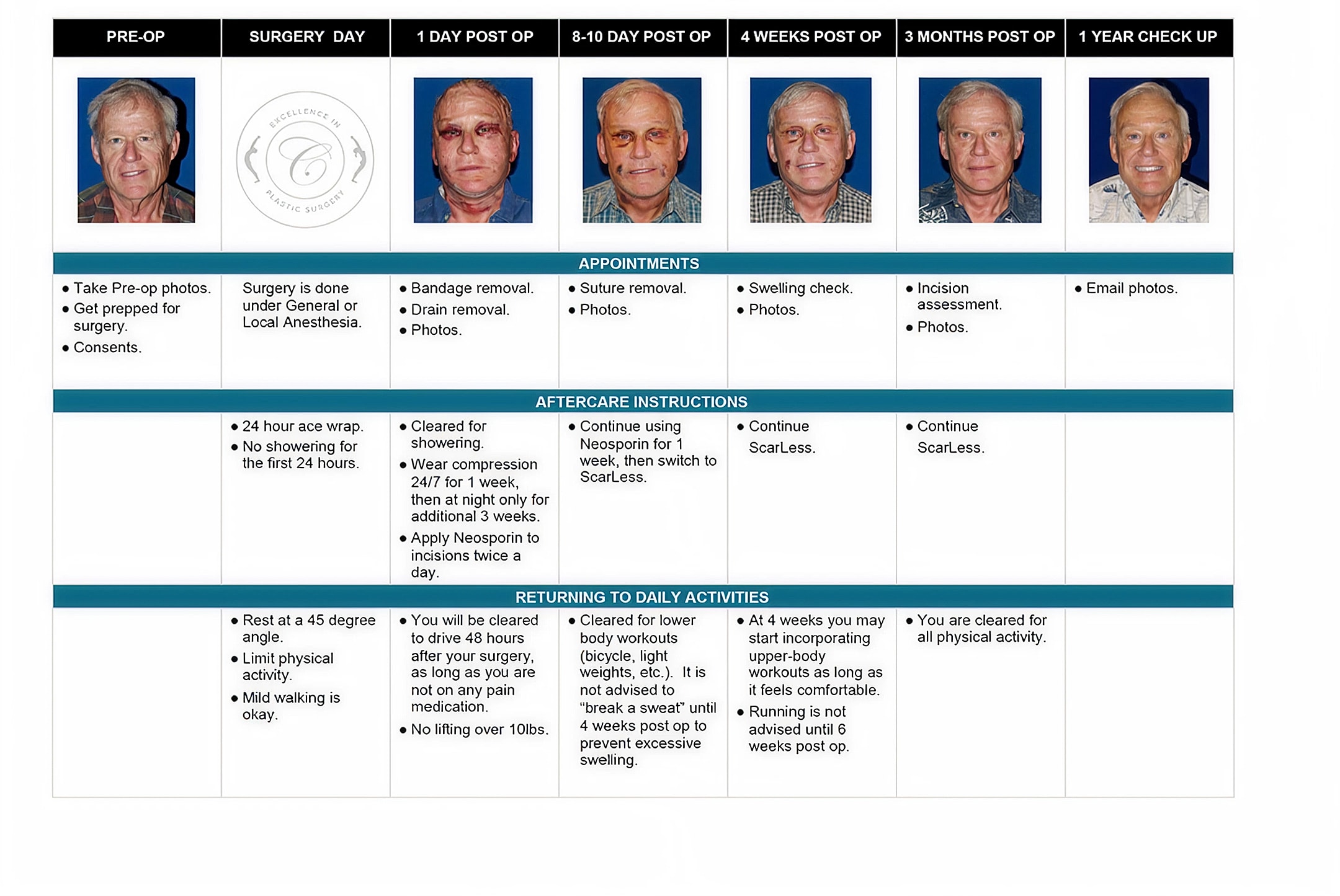
Joseph T Cruise, MD, has found that when patients have access to pictures, they better understand the healing process and what to expect. This allows patients to assess whether the effects they are experiencing after their face or neck lift are typical, and they can quickly discuss any concerns with a staff member at Cruise Plastic Surgery. The male and female recovery timelines below demonstrate what to expect at each stage of the healing process.
Recovering After Face Lift Surgery
"80% of your results come from surgery, 20% from aftercare"
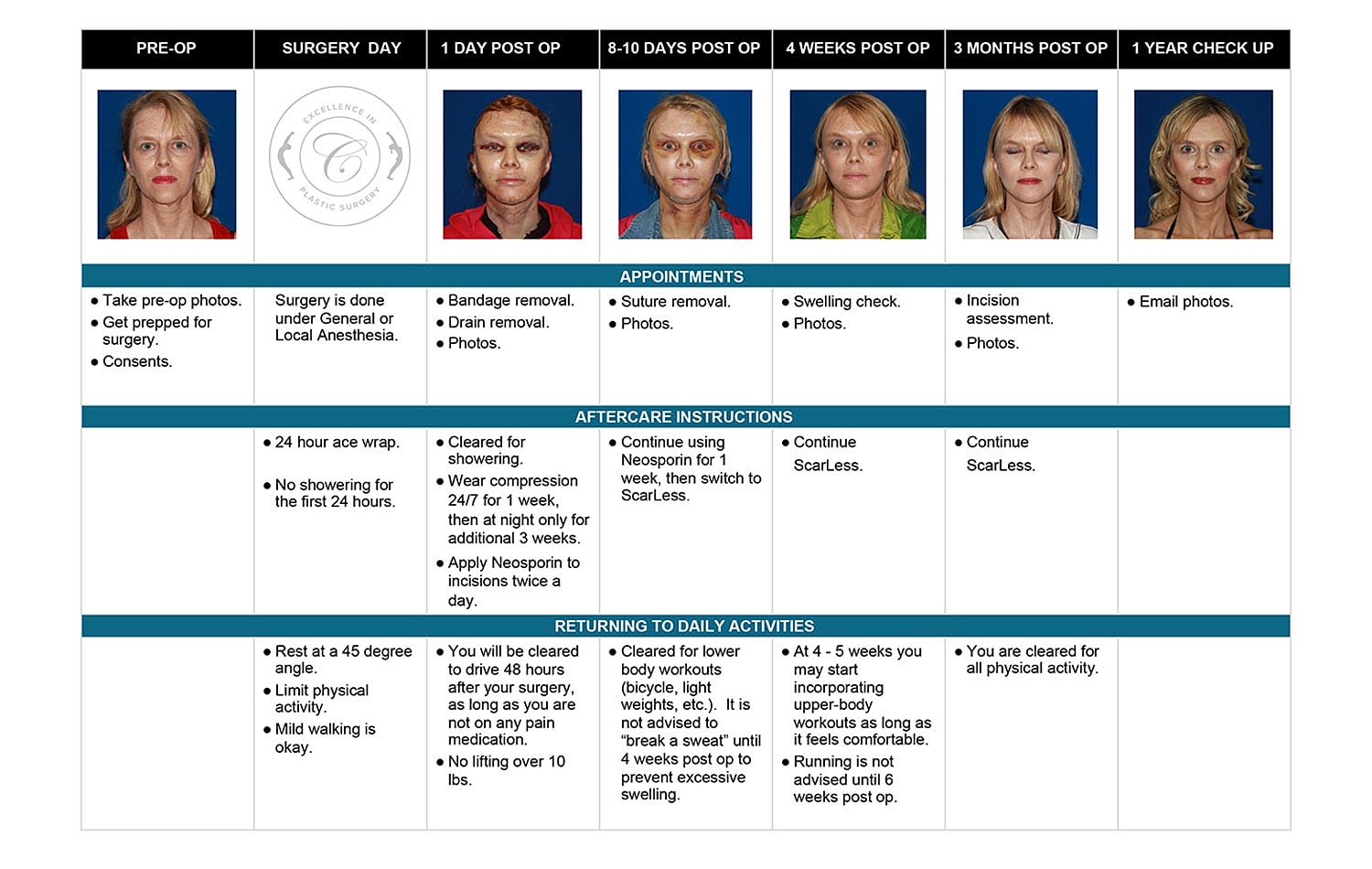
Recovering After Face/Neck Lift & Eyelid Surgery
"80% of your results come from surgery, 20% from aftercare"
A New Reflection of You
Within weeks of facelift surgery, you’ll notice smoother, firmer contours across your cheeks, jawline, and face and neck. Final results continue to refine over the next 3–6 months once swelling has fully resolved.
Patients see improved definition in the lower face and jawline and a smoother, more youthful facial appearance. Visible wrinkles and excess skin are replaced by smoother contours, contributing to better balance and harmony across the face.
Dr. Cruise’s comprehensive technique ensures results that respect the integrity of your soft tissues, delivering long-lasting rejuvenation without sacrificing your natural facial contours.

The Art of Subtle Enhancement
A youthful face will be quickly revealed in the hands of a skillful plastic surgeon. Joseph T Cruise, MD, understands that patients do not want to look “operated on,” and this is a key consideration when performing any type of cosmetic surgery. He is conscious about ensuring that any scarring is minimal, all results are natural-looking, and that his patients recover from their facelift procedures as quickly and easily as possible.
His staff excels at aiding patients through their recovery process, and the Cruise Plastic Surgery proprietary patient management program provides patients with a one-of-a-kind support system. Patients can also utilize this network to contact Joseph T Cruise, MD, or the staff 24 hrs per day for any questions or concerns.
If you think a facelift in Newport Beach might be right for you, schedule your personal consultation with Dr. Cruise today. He will spend time learning about your specific goals, answering all of your questions, and providing you with personalized recommendations based on a careful analysis of your facial structure and signs of aging. Our team is here to provide you with a seamless experience and all the information you need to make informed decisions about the next steps.
When considering facial plastic surgery it can be very helpful to hear from others who have already had it done. Real Self, the number one online resource for learning about elective cosmetic procedures, is a great resource. You can even talk to others to get answers to your questions, receive emotional support, and get tips and advice.
"I first went to Dr. Cruise a year and a half ago for a breast reduction and liposuction. During my initial meeting, I first met with Stephanie, his Office Manager & Surgery Coordinator. Not only was she warm and extremely knowledgeable but she was also responsive each time I reached out to her. Her insight and honesty corresponded with her ability to give me a woman's perspective. Jamie, Dr. Cruise's office nurse, is kind and caring, and she, too, was just a phone call or email away to answer any questions. During that first consultation, I found the same to be true about Dr. Cruise. (But more about Dr.Cruise below) After going through the before-and-after process of my breast reduction procedure, I had built trust and felt very comfortable with Dr. Cruise and his team. So, a few months ago when I decided to take the next step and have a consultation to explore options for a more youthful look, without hesitation, I went back to Dr. Cruise. Again, as with my first procedure, Dr. Cruise answered all my questions with patience, and I never felt rushed or pressured. On the contrary, Dr. Cruise really listened to my wants and gave his honest opinion, and together, along with Stephanie, we came up with a surgical plan, and I'm thrilled with my results. We decided on a neck and lower face lift, a brow lift, and facial fat transfer. He makes it clear that his goal is to make his clients feel amazing inside and out with beautiful, natural results. Beyond his expertise and knowledge, he genuinely cares about his patients. Dr. Cruise is a master surgeon! In addition, his surgical team of nurses and the anesthesiologist were amazing, too, and I woke up from surgery feeling amazing! I am so grateful to Dr. Cruise, to Stephanie, and his entire staff. Thank you all for making this process such a positive experience for me. To anyone considering surgery, Dr. Cruise is the absolute best!"


The three most common types of facelift techniques are a subcutaneous facelift, subcutaneous with fat suspension, and SMAS.
While many people are familiar with the terms mini-facelift, lower facelift, and facelift, what truly defines the type of facelift being performed is the specific technique being used.
Dermal fillers offer a non-surgical option for addressing early signs of facial aging by restoring volume and smoothing lines and folds. This approach is commonly known as a "liquid facelift."
While a liquid facelift can create noticeable improvements, it does have limitations. In cases where a significant amount of filler is needed to achieve the desired correction, the cost can become substantial. Additionally, because fillers are temporary, touch-up treatments are required every 6 to 18 months depending on the type of product used.
Liquid facelifts can subtly lift certain areas of the face and soften wrinkles, but they cannot correct concerns like jowling or sagging neck skin. In fact, trying to correct more advanced signs of aging with excessive filler can sometimes result in an overfilled, unnatural look. For patients with more significant aging concerns, surgical options may offer a more effective and lasting solution.
Determining when the best time is to have a facelift is dependent on how much the signs of facial aging are bothering you. If you find that you avoid looking in the mirror or no longer want to have pictures taken, these are signs it may be time to consider a facelift to restore a more youthful appearance.
We believe earlier prevention is best because less surgery is needed and results are not as obvious to others. We have a fair number of patients who elect to have facelift surgery in their 40s when they begin to notice neck banding, nasolabial folds, and jowling. In addition, when less surgery is needed, local anesthesia may be an alternative to general anesthesia.
Although rare, the risks and complications of facelift surgery include:
In most cases, the answer is no. Joseph T Cruise, MD, uses techniques that greatly reduce the chance of visible long-term scarring. While there are rare instances when a patient does not heal well after facial plastic surgery resulting in less-than-ideal scarring, the vast majority of patients, both male and female, have nearly undetectable incisions after several months to one year post-op.
This will depend on two major factors:
If you don't want anyone at work to know you had "work" done, we recommend taking up to four weeks off.
If your job requires strenuous activity, you may need to take 4-6 weeks off unless your job will let you come back with modified work duties until you are fully cleared for physical activity.
Both local anesthesia and general anesthesia are available. If you are combining multiple procedures into one surgery, general anesthesia will be required. There are other factors that will determine which anesthesia is best suited for you. This will be discussed at your consultation.
Most patients are completely cleared for all physical activity around one month post-surgery. This will vary from patient to patient depending on how the healing process is going.




.jpg)


.jpg)


