
Nose Surgery Rhinoplasty3 Deviated Nose
Nose Anatomy - Deviated Nose
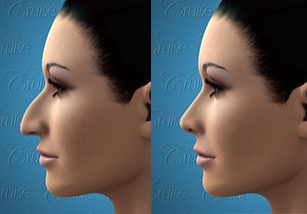
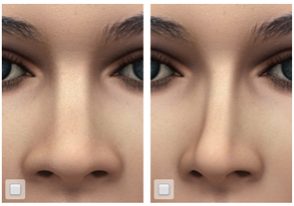
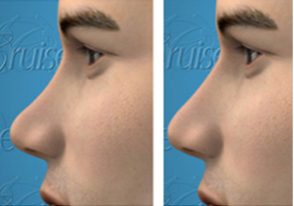
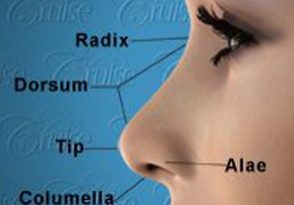
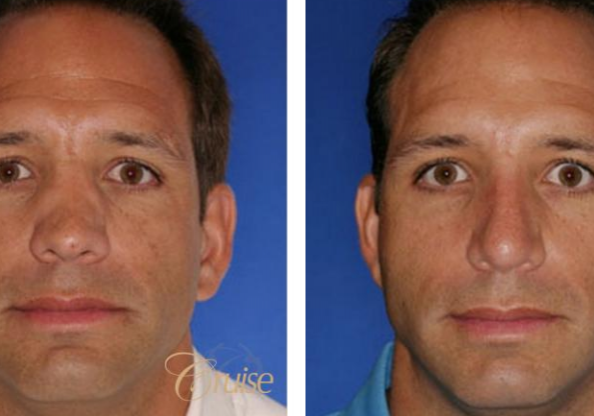

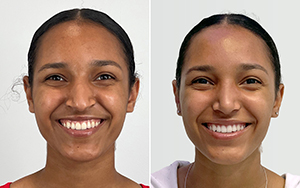

There are many causes of a deviated nose, so it is critical to examine which parts of your nose are causing the deviation.
I find digital imaging most helpful in determining a person's nose anatomy and the type of nose surgery needed to correct a deviated nose.
The first thing to understand is that there is no such thing as a perfectly symmetrical face. One side of the face will always be bigger, one side will be higher, etc. The key to correcting a nasal deviation is to make your nose appear straight on your face even if your face is not straight. This requires creating a nasal mid-line. I do this by marking the mid-line dot directly between the eyes and then marking a mid-line dot of the upper lip. The nasal mid-line is a vertical line drawn between these two dots.
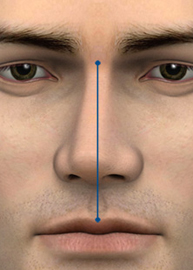
Vertical mid-line clearly shows nasal deviation
From here, I have to determine which parts of your nose are deviated so I can focus treatment on that area. Many people do not realize which part of their nose is deviated until they draw this nasal mid-line for themselves.
The 4 most common areas of nasal deviation are:
- Deviated Nasal Bones
- Deviated Upper Lateral Cartilages
- Deviated Septum
- Deviated Tip (Alar Cartilages)
I encourage you to take a look at each of these areas. This will allow you to see which areas, if any, need to be addressed during your rhinoplasty surgery.
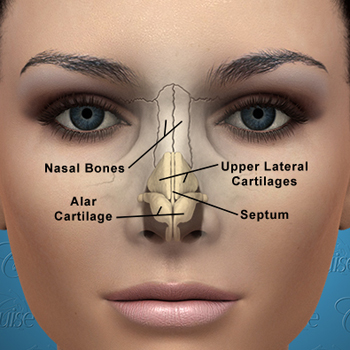
Four most common areas of nasal deviation
Deviated Nasal Bones
Let’s start at the top of the nose and move downward. The first area I evaluate will be the nasal bones. Are they in the mid-line or kicked off to one side? The easiest way to assess for deviation is to utilize the dorsal aesthetic lines (DAL) I talked about earlier. See below:
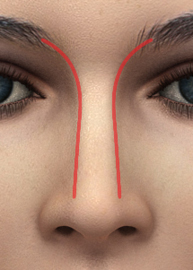 The dorsal lines should form a smooth continuous line extending from the eye brows to the tip of the nose. If the DAL is disrupted, it is likely that that region of the nose is deviated.
When viewing the bridge of the nose from below, each nasal bone should have a similar slope. When the nasal bones are deviated they no longer form a symmetrical triangle. One side will have a steeper angle and the other will be less steep. Correcting deviated nasal bones also requires correcting this asymmetry in the nasal wall slope.
Treatment of Deviated Nasal Bones
Deviated nasal bones are corrected by first performing an osteotomy (breaking the bones).
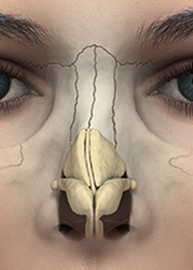
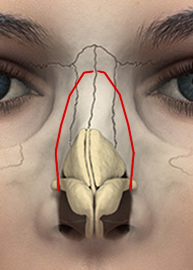
Once the bones are broken, they are shifted toward the mid-line. This not only corrects the deviation but also recreates a nose that has symmetrical side walls. In addition, this usually creates a narrower nose.
Deviated Upper Lateral Cartilages
Located just below the nasal bones are the Upper Lateral Cartilages (ULC).
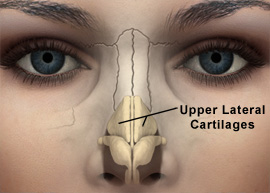
It is not uncommon for one or both of the ULC to be deviated. This may occur with deviated nasal bones or it may not. If it occurs with the nasal bones, the entire dorsum is deviated. If it occurs alone, it simply looks like the nose is pinched.
Treatment of a pinched nose typically involves widening the pinched portion with the patient's own cartilage. These cartilage grafts are appropriately called "spreader grafts".
One-sided ULC deviated
Notice in the images below how when one ULC is weak and deviated, that side of the nose looks pinched. Adding a spreader graft to the deviated side corrects the problem.
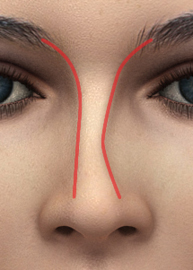
The left ULC is deviated
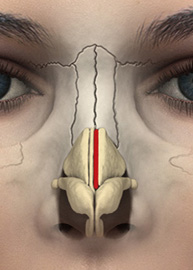
Correction of one sided pinching with spreader graft
Two-sided ULC deviation
If both ULC are weak, both sides look pinched. A spreader graft is added to both sides to correct the deviation. See the images below.
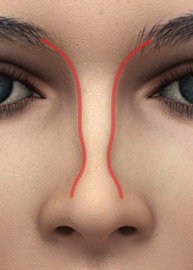
Both Upper Lateral Cartilages are deviated
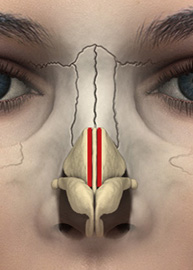
Pinched nose corrected by bilateral spreader grafts
Pinching of the nose is not just a cosmetic problem, rather it is often a functional one as well. This is because the ULC are very important cartilages. They protect the nasal airway. If they are weak or deviated, this may cause airway obstruction.
This is why people with pinched noses are often mouth breathers, especially during exercise. Widening and strengthening the ULC with a spreader graft often corrects this problem AND straightens the nose.
Deviated Septum
Normally, the septum runs straight down the middle of the nose. It is the foundation on which the nose is supported. This is why it is critical that the septum is straight.
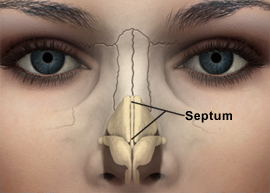
The next picture shows the importance of a straight septum. If the septum is deviated the entire nose will look deviated.
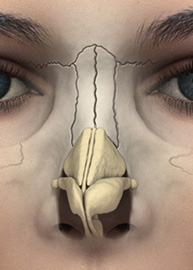
The septum is a very complex structure. Think of it as a support wall that runs the entire length of the nose. It may be deviated in many different places; each having a different effect on the look and function of the nose.
Treatment of Deviated Septum
Treatment requires addressing the individual aspects of the deviation.
Here are the 4 most common techniques that I use:
- Centralizing Suture
- Horizontal Mattress Suture
- Off-Set Suture
- Spreader Graft
- Centralizing Suture to straighten septum between nostril
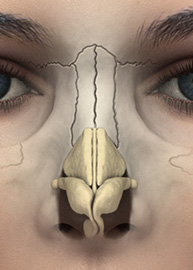
Centralizing suture corrects a deviated septum near the nostril.
Deviation of the septum near the nostrils will not only cause the tip to be crooked but it will make the nostrils asymmetric. A centralizing suture will reposition the septum to the mid-line at the level of the anterior nasal spine.
2. Horizontal Mattress Suture to straighten the bend of the septum
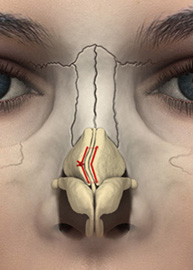
Crooked septum with untied suture
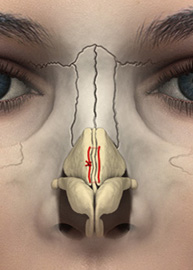
When suture is tied septum is straightened
When there is a bend in the body of the septum as shown above, a Horizontal Mattress Suture will often straighten the bend.
3. Off-Set Suture to pull the septum to the mid-line
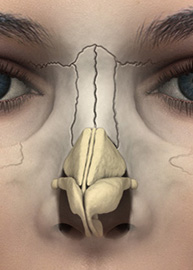
Sometimes a septum can be straight but shifted to one side as shown above. A Horizontal Mattress Suture will not work here because it can only correct a septum that has a bend. This is where an Off-Set Suture is useful as shown below.
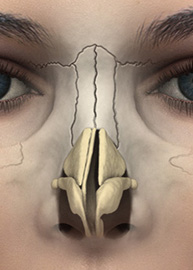
Deviated septum is separated from ULC
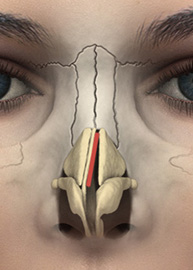
A spreader graft is placed on the left to strengthen ULC
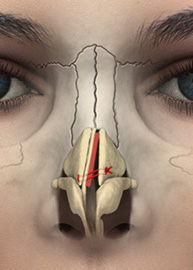
Off-Set Suture is positioned in a diagonal orientation from the septum to the ULC
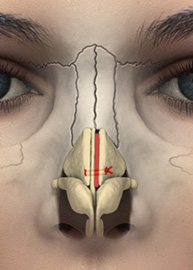
This diagonal orientation pulls the septum to the midline when it is tied
The Off-Set Suture is a very powerful technique that will pull the septum over to one side. It works because the ULC is solid while the septum is more movable. This is why the ULC is able to pull the septum to the midline. Typically, a spreader graft is added to the weak side because in addition to straightening the septum, the ULC needs to be strengthened.
4. Spreader Graft to fill in for weak cartilage
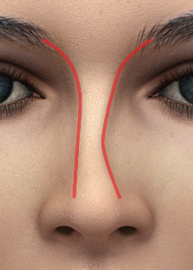
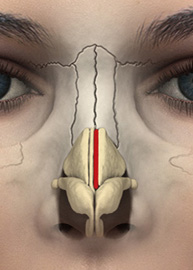
Treatment of weak cartilage typically involves widening the pinched portion with the patient's own cartilage. These cartilage grafts are appropriately called "spreader grafts".
Deviated Tip
Once the nasal bones, the upper lateral cartilages, and the septum are straightened, often the tip deviation is greatly improved if not completely corrected.
The key is to make sure that the two alar cartilages are symmetric and in the midline. Correcting cartilage asymmetries is primarily done with various suture techniques. These sutures adjust the shape of the cartilage as shown below.
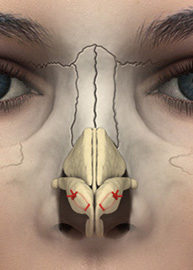
Tip Sutures
Treatment of Deviated Tip
If the asymmetries between the two cartilages are too significant to be corrected by sutures, it may be necessary to augment the weaker side. This is done by using cartilage (usually taken from inner septum) as a graft.
Likewise, if the asymmetry is caused by one side being excessively large then cartilage removal may be the best way to go.

 (949) 446-1421