
Nose Surgery Rhinoplasty4 Tipplasty
Nose Anatomy - Tip
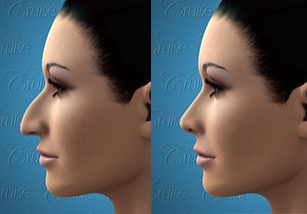
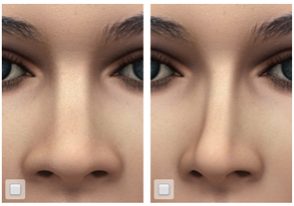
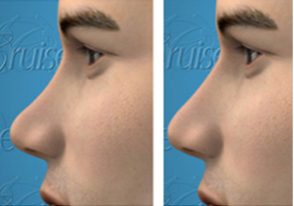
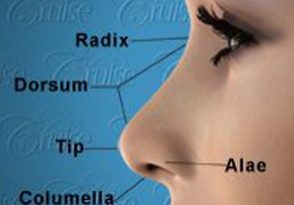



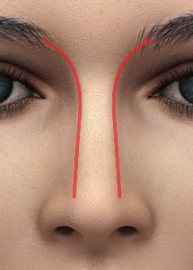 The dorsal aesthetic lines of the dorsum of the nose should ideally continue smoothly into the tip. If the tip is too wide, the dorsal aesthetic lines will widen given a bulbous appearance. If the tip is too narrow the aesthetic lines will give a “pinched” appearance. If the tip is too long it will create a “droopy tip.”
This section will review the most common concerns that my patients have regarding the tip. My recommendation is to go through it and try and relate it to your nose. Having this information makes it much easier to convey what bothers you to your plastic surgeon. Take a look at all the elements of nose anatomy so you know what rhinoplasty is right for you.
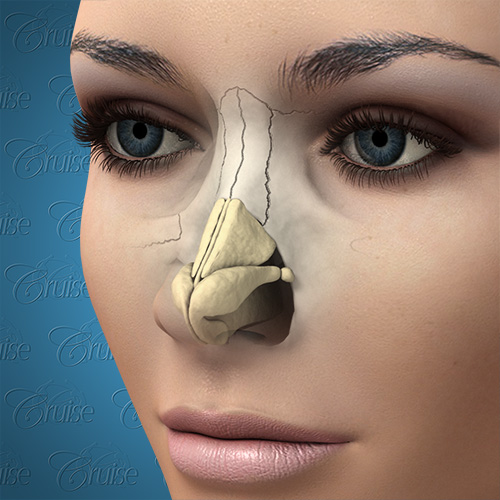
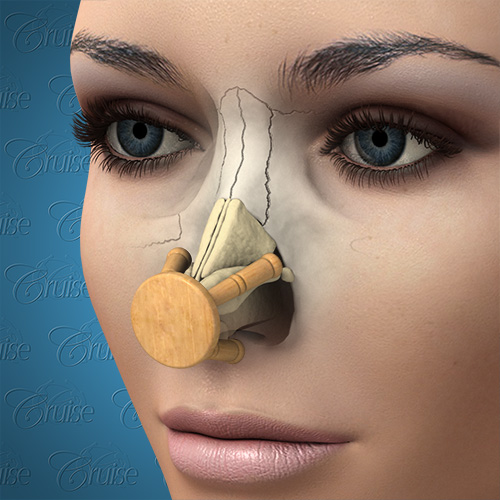
The tip of the nose is made of a pair of cartilages called the Alar Cartilages. The easiest way to envision the nasal tip is to compare it to a three legged chair. The “legs” of the chair give support to the tip. The “seat” of the chair is the tip. To change the height of the tip one must change the length of the legs. To change the shape of the tip one must change the shape of the seat.
Three Legged Chair
Droopy Tip
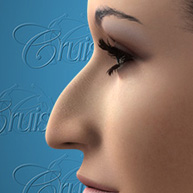
The droopy tip is often caused by a long septum plus long lower lateral cartilages that are essentially pushing the tip downward. The droopiness is usually accentuated during smiling. Sadly, many of my patients say they hate smiling for this reason and often do not smile for pictures. Others say they have to pose in “just the right angle” if they want to get a picture they are happy with.
Treatment of Droopy Tip
The key to correcting the droopy tip is to treat the underlying cause of the droopiness.
Droopy Tip
Droopy tip
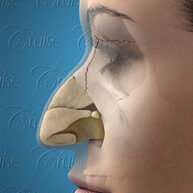
Droopy tips are usually the result of a long septum, a large alar cartilage, or an alar cartilage that is hanging downward.
Outlined below are the four most common techniques that I use to correct a droopy tip. Sometimes I only need to perform one of the techniques but commonly I will use multiple techniques depending on what is causing the droopy tip.
- Shorten the Septum
- Reduce the Lateral Crura of the Alar Cartilages
- Shorten the Membranous Septum
- Suture the Medial Crura to Septum
Shorten the Septum
Often the tip will be pushed downward by a long septum. Shortening the septum effectively removes that portion that is causing the droopiness.
Notice, below on the left, an example of a typical droopy tip. Below, on the right, we have removed all the cartilages except the septum so we have a better view of the septum alone.
Treatment of Droopy Tip
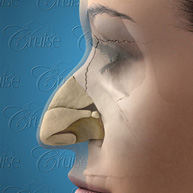
Example of droopy tip
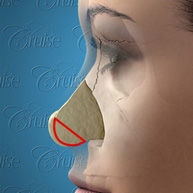
Shortening a long nose often requires removing the part of the septum outlined in red

Result after shortening the septum
When the septum is long as shown above, it will cause the tip of the nose to hang down over the upper lip. Shortening is accomplished by removing the part outlined in red.
Reduce the Lateral Crura of the Alar Cartilages
The septum is not the only cartilage that can push the tip downward and cause droopiness. The other cartilage that can be involved is the Alar Cartilage. This is best demonstrated by the comparison of the alar cartilages to a three-legged chair.
Lateral Crura Visualized
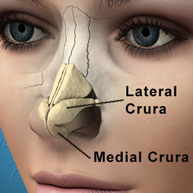
Each alar cartilage has two components; the lateral crura and the medial crura. The lateral crura form the two top legs of support of the tip. Both medial crura combine to form the third leg located between the nostrils.
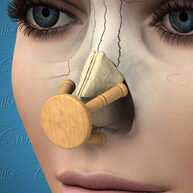
Tip support can be likened to a three legged chair as shown. Tip location and projection are determined by the length of these legs. Tip shape is determined by the shape of the seat.
There are two alar cartilages; one on each side. Each alar cartilage has two parts
- The medial crura (which goes between the nostrils) and
- The lateral crura.
If the lateral crura is long it will push the tip downward. This is corrected by shortening the lateral crura.
More commonly the lateral crura will be enlarged as shown below. This enlarged cartilage will push the tip downward much like the long septum does.
Lateral Crura Correction
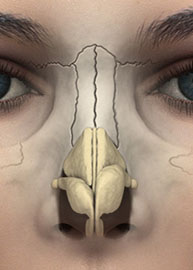
Example showing an enlarged lateral crura on one side
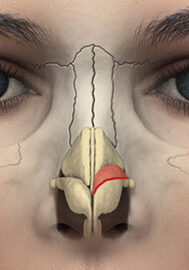
Cephalic Trim - Area in red is removed. This corrects a droopy tip by causing the nasal tip to shorten.
Correction of an enlarged lateral crura is called a cephalic trim. This is a fancy way of saying that the upper part of the lateral crura is trimmed.
A cephalic trim has several benefits. When the lateral crura is made smaller the entire tip will rotate upwards; thus, improving the droopy tip. In addition, removing this enlarged tip cartilage will make the tip less bulbous and more defined. This is described more later.
Shorten the Membranous Septum
Sometimes the nasal tip is pushed downward without the septum or the alar cartilage being at fault. It is not uncommon for the membranous septum which connects the alar cartilage to the septum to simply weaken and stretch.
This happens to almost everyone as they age. This is why it seems as if the nose gets bigger with age. This is not usually the case. It simply sags downward like many other parts of the body. Shortening the enlarged membranous septum will elevate the tip into proper position.
Enlarged Membranous Septum Visualized
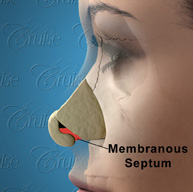
Normal membranous septum (shown in red) holds alar cartilage tightly to the septum
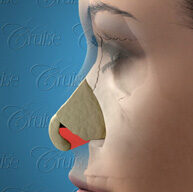
Example of an enlarged membranous septum causing the tip to droop
Suture the Medial Crura to Septum
Direct suturing of the lower lateral cartilages up to the septum is a very powerful way of correcting a droopy tip. I use it when it appears as if the preceding three techniques are still not going to obtain the desired elevation.
Medial Crura to Septum Suture
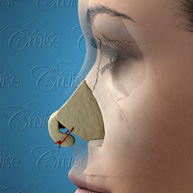
A very effective way to correct a droopy tip
Over-Projecting Tip (Pinocchio Nose)
Over projecting tips are most common among Northern European descendants. They are commonly caused by excessive amount of cartilage supporting the tip.
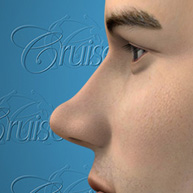
Over-projecting tip
Let's take another look at our three-legged chair analogy to find out exactly what causes an over-projected tip
Tip projection is determined by the length of the lateral and medial crura of the alar cartilages.
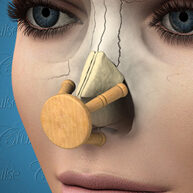
Deprojecting the tip can be accomplished by shortening the length of the legs.
As you can see, the biggest contributor to an over-projected tip is a long and powerful medial crura. When the medial crura is very strong, it literally acts like a tent pole and props the entire tip upward.
An overly powerful septum and lateral crura can also be responsible for excessive tip projection.
Treatment of Over-Projecting Tip
There are several techniques to deproject a nasal tip. In fact, the rhinoplasty surgeon is often trying to increase or maintain tip projection not decrease it. While a small amount of de-projection is relatively easy to accomplish, significant de-projection is much more challenging and requires aggressive techniques.
The first step is to detach the medial crura from the septum. This weakens the stability of one of the “legs” causing the tip to "slide down". If this is not enough, I will often shorten the "legs" of the medial crura. As you can imagine, this can dramatically decrease the height and is usually all that is needed.
It is important to know that when the tip is deprojected the alae will flare outward a little bit. Often this is desirable because these patients often have narrow, elongated nostrils.
If it is not desirable then this flaring can be reduced either at the same time or at a second stage. Visit the section on Alar Flare Reduction to learn more.
The key with the over projecting tip is to reduce the tip so that it is proportionate to the rest of the nose and the face.
Under-Projecting Tip
The under-projecting tip is very common and can be more challenging than the over-projecting tip. It is seen in almost all ethnicities particularly Asians, Latinos, Middle-Easterners, and Afro-Americans. There are two common subgroups within the under-projecting tips. One group is associated with an under projecting dorsum (flat bridge) and the other is associated with an over projecting dorsum (i.e. large hump).
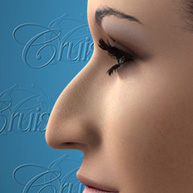
Under-projecting tip with over-projecting dorsum
This type of nose is common within the Middle-Eastern and some Latin communities. The tip under-projection is deceiving. This is because the very strong dorsum/septum projects the entire nose and the tip. This gives the tip the appearance that is supported and defined but in reality it is not.
It is absolutely critical for the surgeon to be prepared to support the tip during the preoperative plan. Tip support usually means that the medial crura will need to be strengthened. If the tip (medial crura) is not strengthened the tip will become droopy, bulbous, and unattractive.
The way to determine if you have an under-projected tip is to push on the tip with your finger. If the tip easily is pushed into the face with little resistance then support is necessary. If the tip has good strength then it will not push into the face. Here, the tip will have a “bounce” to it that represents resistance to the pushing.
If the tip does not have support it is because the legs of the “chair” are not very strong. Adding support to the tip requires strengthening these legs by adding cartilage. The most common method of adding cartilage for tip support is called a Columellar Strut.
Tip Support with Graft
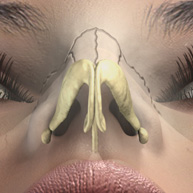
View from below the alar cartilage
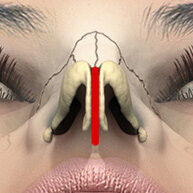
Columellar strut graft provides tip support
With a columellar strut, a strong piece of cartilage is harvested usually from the inside of the nose and placed in between the medial crura. This turns this weak “leg” into a strong “leg” and gives the tip the support that it needs.
Under-Projecting Tip With Under-Projecting Bridge

Common asian nasal appearance
This is most common in the Asian community. We have already discussed this within the under projecting dorsum section. Typically, in this type of a nose, virtually all its components are very small. This includes the nasal bones, the dorsum, and the tip. The three “legs” are often very small, short and very weak and give almost no support at all.
Treatment of Under-Projecting Tip with Under-Projecting Dorsum
Treatment involves creating a tip either with cartilage or with a nasal implant. Patients with thick skin on the tip of their nose require very strong tip support in order to get an elegant defined tip. Typically, these patients have tips that are very round and bulbous with no definition.
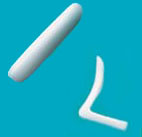
Examples of silicone nasal implants
These patients are ideal candidates for a nasal implant. Caution iscritical. Trying to create too much tip support will put pressure on the skin and may cause it to thin; as always, surgeon's experience is paramount.
My treatment of choice for this type of nose is to create the tip with the patient's own cartilage. This way there is no concern about the tip of the nose thinning out from the implant. Then, I will use a small implant to build up the bridge of the nose.
Tip Definition
One of the most common requests that I have from my rhinoplasty patients is to create a more attractively shaped tip. Often, they simply complain that their tip is “too big.” Let’s look at what is responsible for tip shape and what are the most common treatments.
Before we do, it is very important to understand that tip definition is limited by the thickness of the skin. If you have very thick skin it will not be possible to create a narrowly defined tip. The skin will simply not allow it.
Bulbous Tip
A bulbous tip generally means that the tip cartilages are too big. Correcting a bulbous tip usually requires making these cartilages narrower. This is typically done by removing a strip of the alar cartilage. This procedure is called a Cephalic Trim.
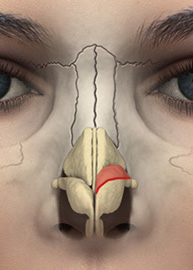
Cephalic Trim to correct bulbous tip
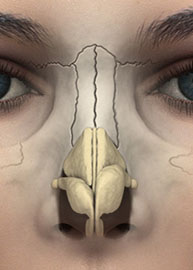
Bulbous tip on patient's left side
Above left, the patient's left alar cartilage was enlarged to show what a bulbous tip looks like. The right side was purposely kept ideal for comparison.
Above right, the area in red demonstrates what needs to be removed to create the ideal tip.
Please understand that there are other factors that contribute to a large, bulbous tip. An enlarged alar cartilage is perhaps the most common.
Boxy Tip
When looking at the nose from below it will ideally have a triangular shape. A boxy tip will have a rectangular shape. It is common for a nose to be both bulbous and boxy.
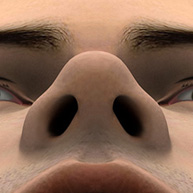
Ideal nose
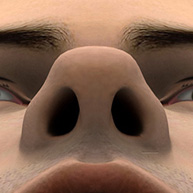
Boxy tip
Correcting a boxy tip involves using sutures to change the angle of the tip cartilages. Changing the angle changes the shape of the tip from a rectangle to a triangle.
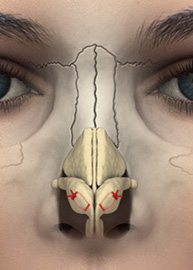
Tip sutures used to create a more defined, triangular tip

 (949) 446-1421