
Nose Surgery Rhinoplasty2 Dorsum
Nose Anatomy - Dorsum (Bridge of the Nose)
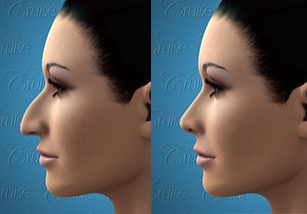
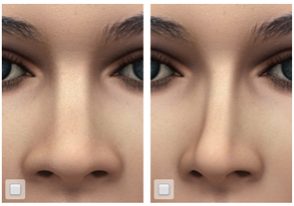
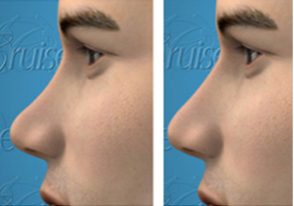
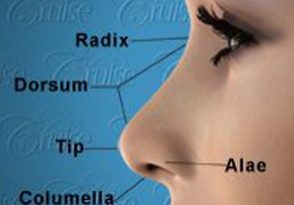



The nasal dorsum is also called the “bridge” of the nose. It has considerable influence over the aesthetics of the nose and the entire face. It is called “bridge” because it connects the tip of the nose to the face. As shown in the section on nose anatomy, the upper half of the dorsum is made of the nasal bones. The lower half of the dorsum is made of cartilages called the upper lateral cartilages (ULC).
Frontal View
When looking at the nose from straight on, the dorsum should form graceful aesthetic lines that connect the eyebrows to the tip.
These aesthetic lines should run smoothly. Interruption or poor position of these lines will cause the nose to look uneven or disproportional.
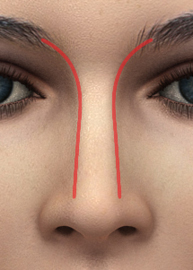
Ideal dorsal aesthetic lines (DAL) run smoothly from the brow to the tip of the nose
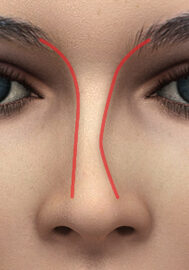
Pinched noses will have a disruption of the DAL
While there is not an “ideal” shape of the aesthetic lines it is important that they run essentially parallel through the bridge with a gentle flare as they run into the tip. It is important for the rhinoplasty surgeon to create harmony within the nose by designing aesthetic lines specific for each patient.
Profile View
Just like on the front view, the profile view should show a smooth, continuous line extending from the forehead to the tip.
Ideal Dorsum

Notice the smooth continuous line extending from the forehead to the tip of the nose
Large Dorsal Hump
This type of nose is very common in my practice. The hump is caused by large nasal bones, a large septum, or most commonly both.
Dorsal Hump Visualized
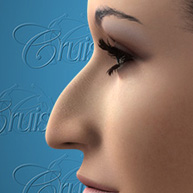
Large hump and droopy tip
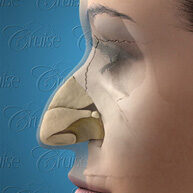
Anatomy view showing hump caused by enlarged bone and cartilage of the dorm
Treatment of Dorsal Hump
The hump is routinely caused by both bone and cartilage. Correction involves reducing the bones and cartilages to the desired height. Removing too little will not completely fix the problem. Removing too much will create a ski jump or saddle nose deformity.
Once the precise amount of hump is removed you are routinely left with what is commonly called an open roof. If uncorrected, this open roof will create a very flat dorsum that clearly looks “operated on." See below:
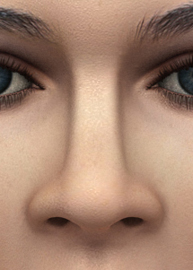
Characteristic harsh, wide nasal bones from a hump that was "chopped off". Narrowing the dorsum requires an osteotomy to close the open roof
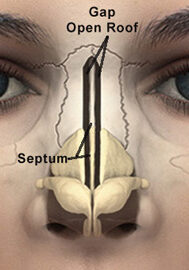
This shows you the anatomy of the hump that is removed. Notice the "open roof" that is created. This is corrected by breaking the bones and converting the open roof to an elegant triangle
The open roof deformity is best explained by comparing the triangular shape of a mountain top. If you were to cut the very top of the mountain off you would be left with a flat top.
Treatment of Open Roof
To correct the open roof it is necessary to reposition the bones to recreate a more triangular appearance. This is called an osteotomy which means that that the bones were surgically broken and repositioned.
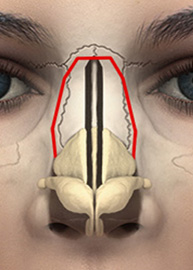
The red lines show exactly where the nasal bones are broken.
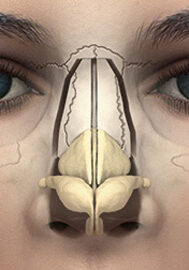
Example of how the bones come together after the osteotomy to bring them back into proper alignment. The bones heal in their new position in 6-8 weeks.
So exactly how much should you take off the hump? Well, this depends on several things. Many men want essentially a straight dorsum. Too much removed may begin to feminize the nose. Of course, this depends on his facial characteristics and desired look.
Dosurm Appearance - Male
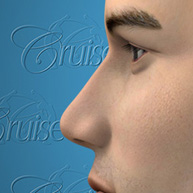
Straight dorsum
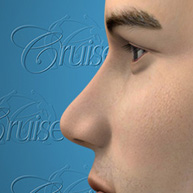
Slightly concave dorsum
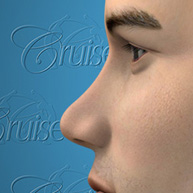
Moderately concave dorsum
Take a very close look a the profiles above; especially between the straight dorsum and the slightly concave dorsum. The differences are subtle, yet can make a big difference in the overall appearance of the nose and the entire face.
Many men prefer a stronger nose. Perhaps even a nose with a hint of a hump remaining. Ethnicity, facial proportions, and personal preference all factor into this decision. This is where digital imaging is helpful. It allows you to get an idea of how you would look with varying degrees of your hump removed. Keep in mind, the surgeon cannot guarantee you the result demonstrated, but certainly the predictability of the result depends on the skill and experience of the surgeon.
Women may want a straight dorsum or, not uncommonly, a slightly concave dorsum. The slight concavity creates a certain cuteness about the nose, whereas, a straight nose may have a more elegant look.
See what you think below. Notice how the shape of the dorsum changes the shape of the nose and the entire face.
Dorsum Appearance - Female
Straight dorsum

Slight concave dorsum

Moderately concave dorsum
Wide Nose
Another common concern my rhinoplasty patients describe to me is that their nose is “too wide”. They want their nose to be made narrower so it is more proportional to their face.
When discussing nasal width it is critical to clearly express what you are wanting to acheive. There are four common widths that you need to understand. These are demonstrated below so you can explain specifically to your plastic surgeon what you want to accomplish.
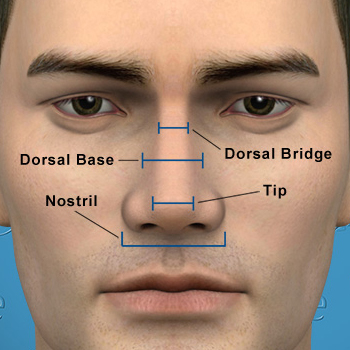
The four different types of nose widths
Each of the four different nasal widths require a completely different approach. Keep in mind, depending on the structure of your nose there are limits to how much individual noses can (or should) be narrowed. Still, it is important to point this out to your surgeon so he understands which nasal widths you would like narrowed (or widened) and which ones you do not.
The width of the alae (nostrils) and tip are discussed in the Alae and Tip sections. Here, we are discussing only the two types of widths of the dorsum.
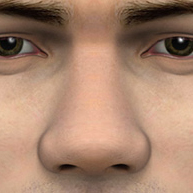
Example of both a wide nasal base and wide nasal bridge
Treatment of Wide Nasal Bones
Narrowing the nasal base requires an osteotomy “breaking the bones,” where the nasal bones meet the facial bones (maxillary bones). This is done with a sharp osteotome and is done through a very small incision inside the nose. I know this sounds very painful but in reality it is not at all. I perform osteotomies in the vast majority of my rhinoplasties to either narrow or reshape the bones.
Narrowing the Nose
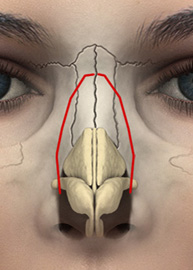
How to narrow a wide nasal base. The red line represents fracture line
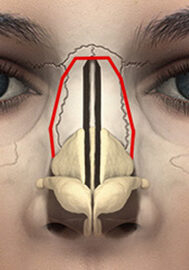
How to narrow a wide nasal base and wide bridge. The gap in the center represents removal of bones
The above picture to the left shows how to narrow a wide nasal base. The red lines represent the fracture line that is created by a sharp osteotome. The osteotome usually is inserted through the nostril and leaves no incisions. The bones are fractured in a very exact fashion.
The above picture to the right shows how to narrow both a wide nasal base and a wide bridge. The difference here is that a center strip of the wide bridge is removed in addition to the red fracture lines. Removing this strip allows both the base and the bridge to narrow when the bones are brought together. Look below to see how it all comes together.
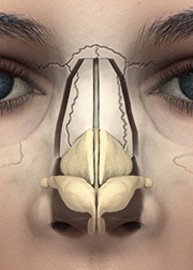
Closed nasal bones after removal of central bone and osteotomy
Another common reason for performing this osteotomy is to close an “open roof” as described in the large dorsum hump section. The osteotomy is the same in both instances.
Under-Projected Dorsum
There are two major causes for the under-projected dorsum. One is caused naturally. This is a very common complaint of my Asian patients. They routinely have an under-projected dorsum as well as an under-projected nasal tip. The key is to create more projection but still retain a very natural look. Here, both the dorsum and the tip need to be enhanced. This is covered in more detail within the Nasal Tip section.

Under-projected dorsum and tip
The second cause is by over reduction of the hump during a rhinoplasty. This can cause what is known as a saddle deformity or a ski slope appearance of the dorsum.
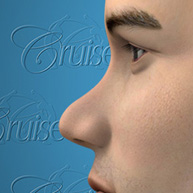
Saddle deformity / Ski slope deformity
Treatment of Under-Projected Dorsum
Correction of both the dorsum and the tip can be accomplished three ways. The simplest way is what I use for minor problems. In these situations I can simply inject a soft tissue filler such as Radiesse®, Restylane® or Juvéderm®. These products often last years in the nose and have the advantage of being low cost with essentially no down time.
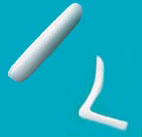
Examples of silicone nasal implants
The second way utilizes a pre-made silicone implant. The implant is precisely inserted into an exact pocket to obtain the desired look. It usually can be done under local anesthesia and does not require that you go to sleep. Recovery is relatively quick usually with minimal bruising and minimal swelling.
The third way is to use the patient’s own cartilage. The cartilage is taken from either the nose or the ear and then sculpted and placed on the dorsum of the nose to obtain the necessary height. All three techniques have their strengths and weakness.
A word of caution; nasal implants are excellent when used properly and used for the correct reason. They can provide exactly what is necessary in a very predictable fashion but they must not be over-done. They are extremely effective to augment the dorsum, however they are not as reliable to correct the nasal tip. This is why I strongly prefer to use only the patients own cartilage to enhance the tip.

 (949) 446-1421